How Does Artificial Intelligence Actually Work?
Artificial intelligence is everywhere. It can answer questions, recognize faces, translate languages, recommend videos and even create images, music and text. But how does artificial intelligence actually work?
The technology may seem mysterious, but its basic idea is easier to understand than it first appears.
Artificial intelligence works by using computer systems that can process huge amounts of information, identify patterns and use those patterns to produce an answer or make a prediction.
How Does AI Learn?
One of the most important technologies behind modern AI is machine learning.
Instead of programming a computer with every possible answer, developers give an AI system large amounts of data. The system analyzes that information and searches for patterns.
For example, an AI designed to recognize cats can be trained using thousands or millions of images. During training, the system learns which visual patterns are commonly associated with cats.
Over time, the AI becomes better at recognizing similar patterns in images it has never seen before.
What Are Neural Networks?
Many modern AI systems use artificial neural networks. These are mathematical models inspired loosely by the way biological brains process information.
A neural network contains layers of interconnected mathematical units. Each layer processes information and passes the results to the next layer.
When an AI analyzes an image, for example, early layers may detect simple features such as edges and shapes. Deeper layers can combine those features to identify more complex objects.
This process allows AI systems to recognize extremely complicated patterns.
How Does ChatGPT Generate Answers?
Generative AI systems such as ChatGPT work differently from a traditional search engine.
During training, a language model processes enormous amounts of text and learns statistical relationships between words, phrases and ideas.
When you type a question, the model analyzes the context and generates a response based on patterns it learned during training.
It does not simply search a giant database and copy an answer. Instead, it generates text step by step by predicting what information should come next.
Why Does AI Sometimes Make Mistakes?
Artificial intelligence is powerful, but it is not perfect.
An AI system can produce incorrect information, misunderstand a question or generate an answer that sounds convincing but is actually wrong.
This can happen because AI models learn from data, and that data can contain errors, gaps, biases or conflicting information.
AI also does not understand the world exactly like a human does. It processes information using mathematical models and patterns.
Does AI Think Like a Human?
Not in the same way.
Although AI can perform tasks that appear intelligent, modern AI systems do not have human consciousness or emotions simply because they can generate sophisticated answers.
AI can recognize patterns, make predictions, solve certain problems and generate content, but these abilities should not automatically be confused with human understanding.
Why Is AI Becoming So Powerful?
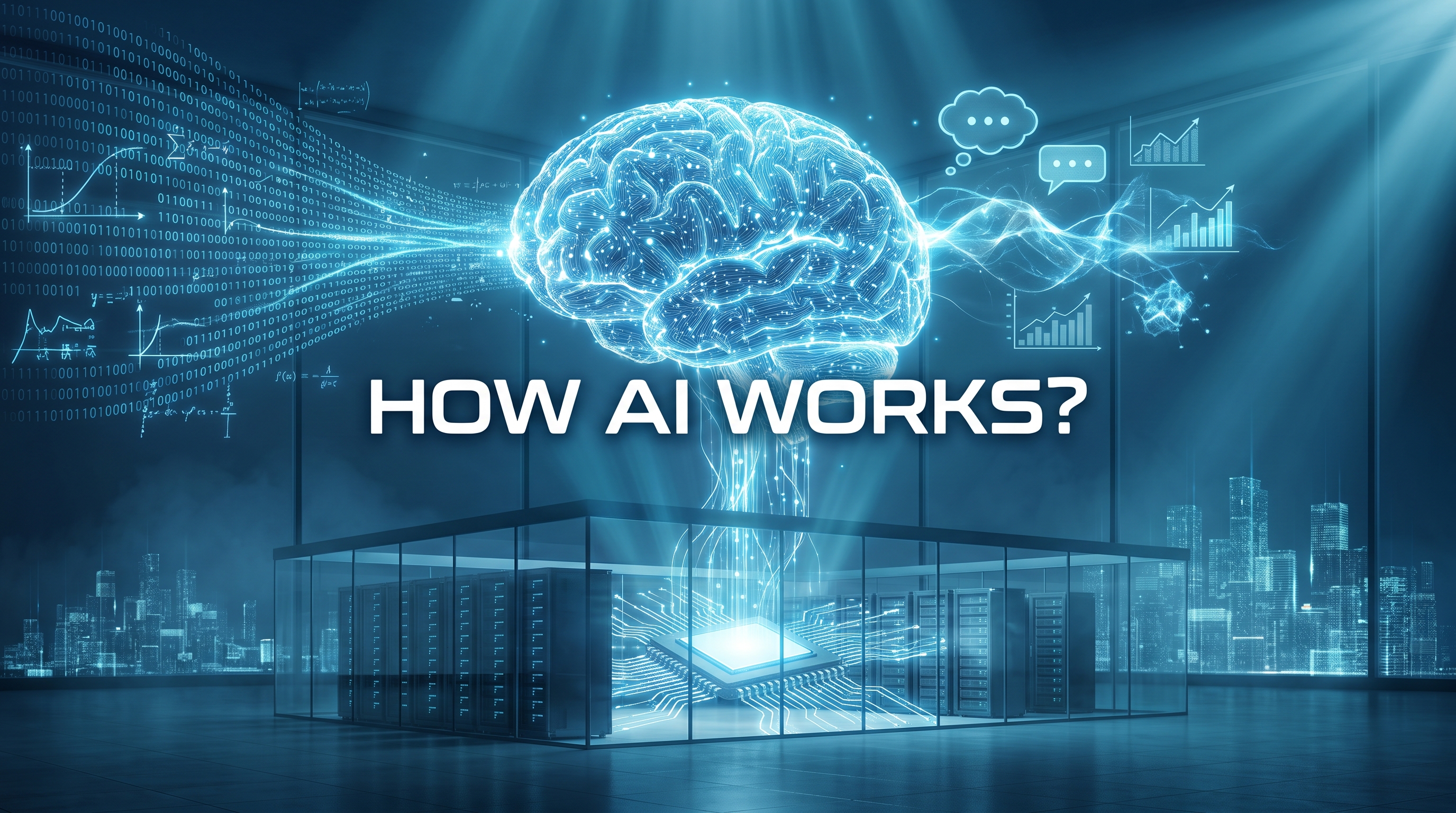
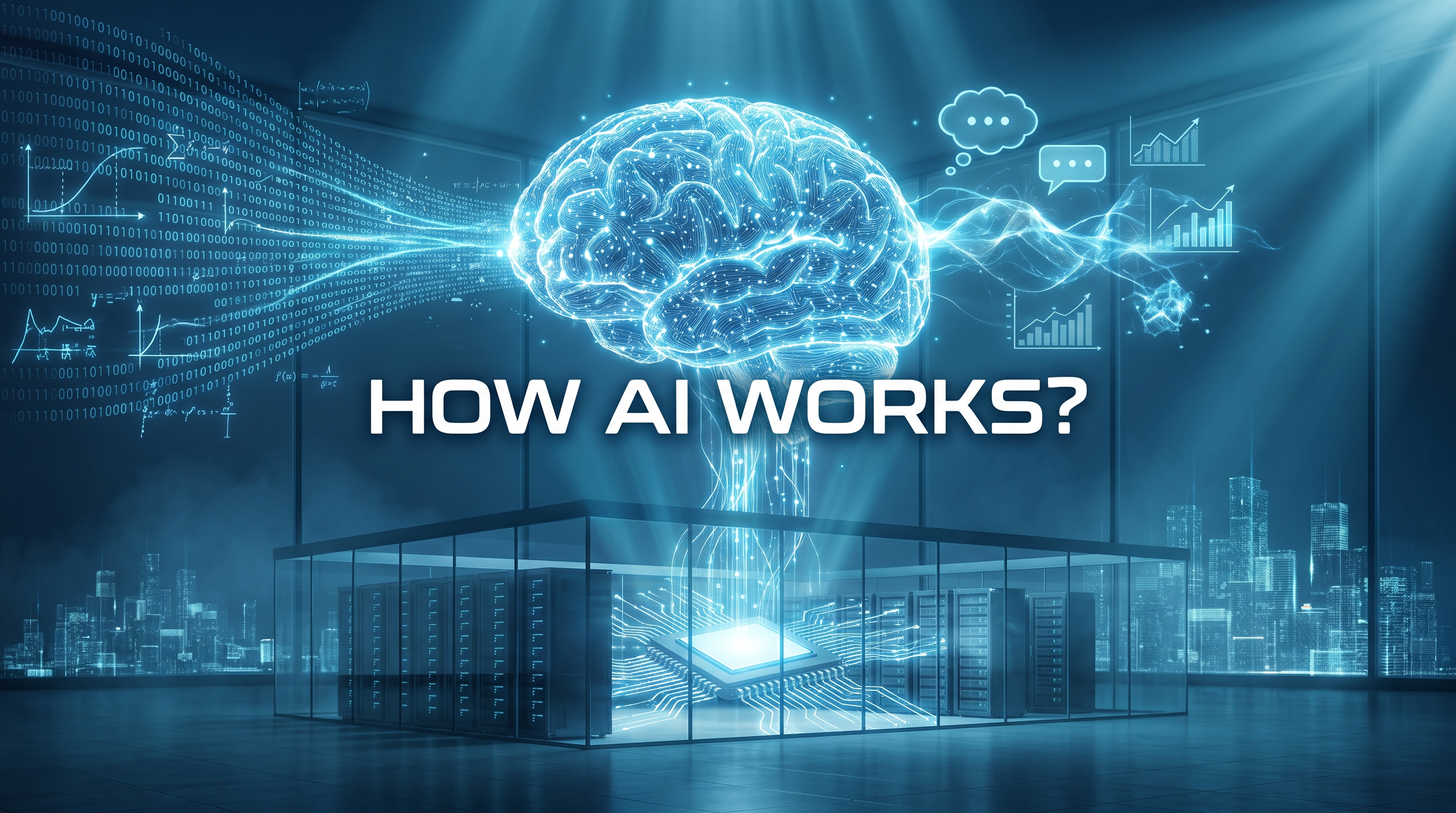
One major reason is the combination of enormous datasets, powerful computer hardware and increasingly sophisticated algorithms.
Modern processors can perform billions or even trillions of mathematical operations, allowing AI models to be trained on vast amounts of information.
As computing power, algorithms and available data continue to improve, AI systems can perform increasingly complex tasks.
The Future of Artificial Intelligence
Artificial intelligence is changing how people work, communicate, search for information and create content.
From healthcare and science to education, transportation and entertainment, AI is becoming part of many areas of modern life.
Understanding how AI works is becoming increasingly important because the technology is no longer limited to laboratories or research centers.
Behind every AI-generated answer, image or recommendation are algorithms, data, mathematics and enormous computing power.
What looks like intelligence on the screen is the result of machines learning patterns from data and using those patterns to produce new results.